

The Put Diagonal
Short a Stock While Capitalizing on Short-Term Volatility

This week we are going to discuss The Long Put Diagonal. I covered the Call Diagonal last week; this structure is the bearish version of a Diagonal spread. We buy a Long Put in a later term expiration and sell a Short Put in a nearer term expiration.

Details
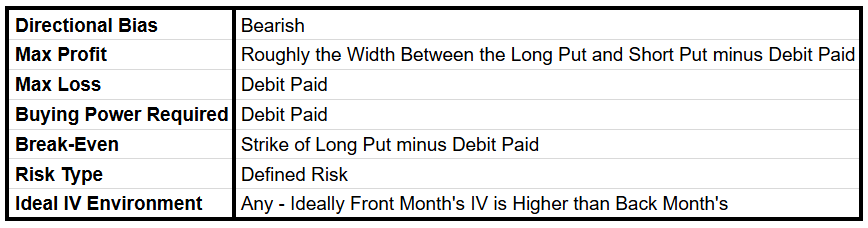
A Long Put Diagonal is bought with the assumption that the stock will go down in the future. The typical construction involves buying a Long Put in a longer dated expiration and selling a Short Put in a shorter dated expiration.
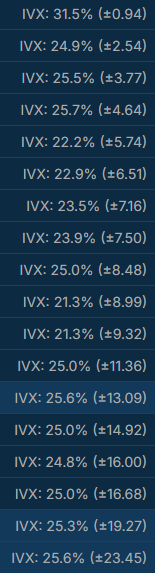
I like Diagonal Spreads as a way to express a bearish (constructed with Puts) or bullish (constructed with Calls) assumption. The great thing about this spread is we use the extrinsic value of the sold Put to offset the cost of the bought Put. This can be a great earnings trade since the nearer term Short Put will have a higher Implied Volatility (IV) compared to the IV of the Long Put. You can see what I mean in the image below for IWM 0.00%↑. The IV Index (IVx) is slightly higher in the near term; a better example was with NVDA 0.00%↑ in my post last week (link above).
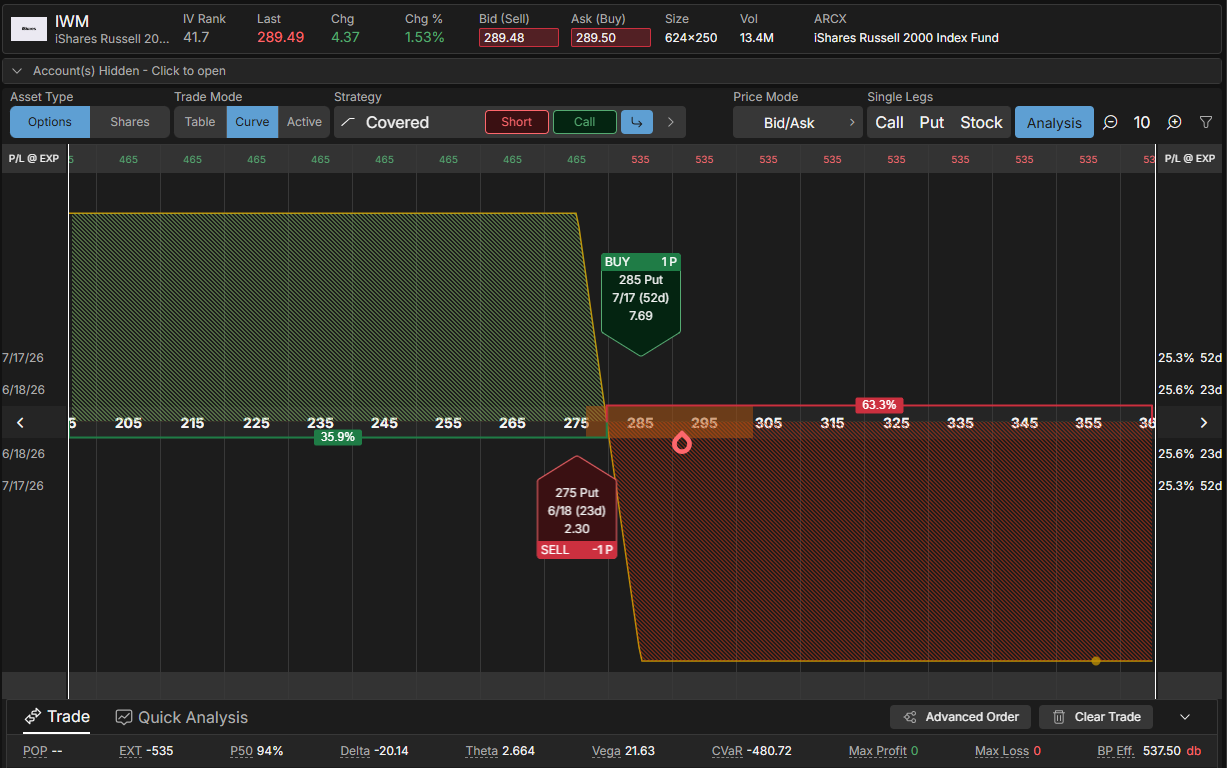
Below is an example Put Diagonal profit and loss graph in IWM.
The image below shows how this trade would be structured in an options table.
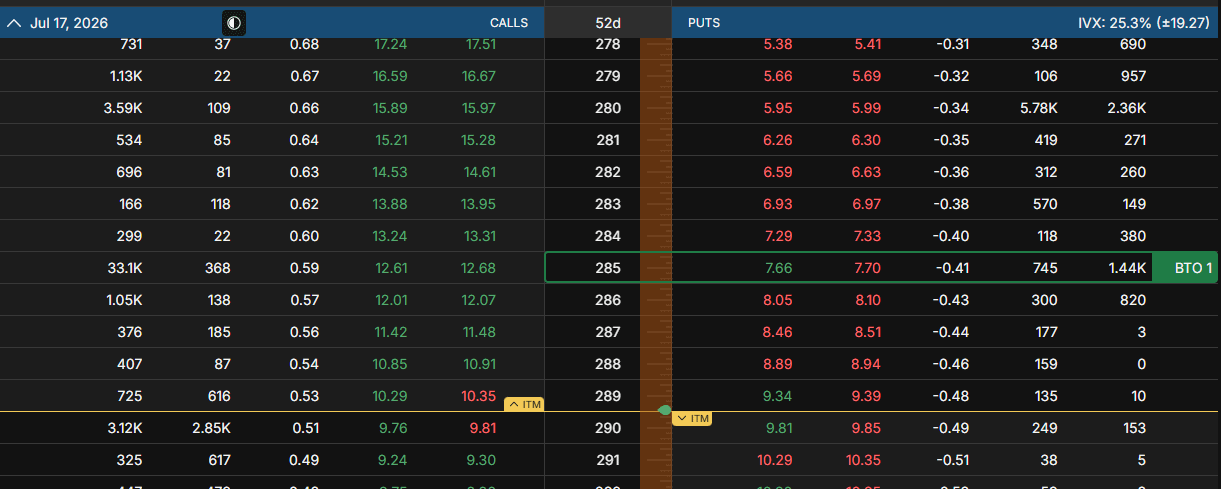
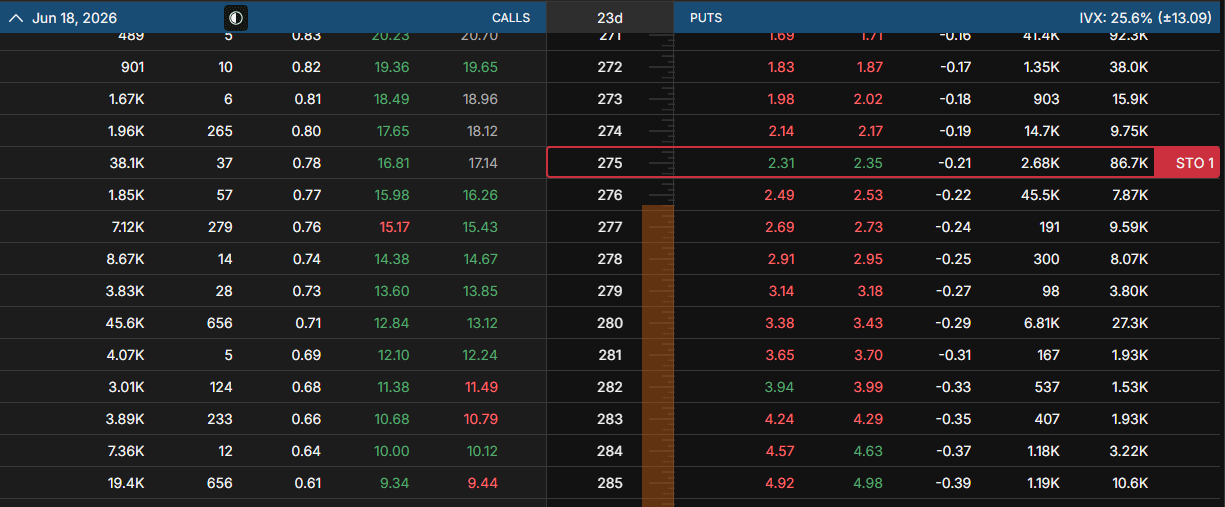
With this trade, we are assuming the price of the stock will go down. A Put Diagonal is a defined risk trade; our max loss is the debit paid at entry. In the above images, I am buying the $285 Put in the July 17th expiration and selling the $275 Put in the June 18th expiration (IWM was trading at $289.49 when I put this together). This trade would be routed for around a $539 debit ((7.69 - 2.30) * 100).
Ideally, we want to enter this trade when the IV of the stock is higher in the near term. This is why it can be a great earnings trade. It allows a trader to benefit from an IV crush in the Short Put. This can also be a great trade to put on for a bearish delta hedge. When entering this example trade, we want the price of IWM to stay below $285 through expiration (ideally).
Breaking it Down
In order to profit on this trade, we MUST be directionally correct. If the price of IWM rises, we will lose money. However, all we can lose is the $539 we paid to enter the trade. Additionally, we give ourselves time to be right by buying that Long Put in a later expiration date.
With a Put Diagonal, our max profit is roughly the width of the spread minus our debit paid. In this above example, our max profit is roughly $461 ((285 - 275 - 5.39) * 100) and our max loss is our debit paid of $539. I say that the max profit is roughly the width of the spread. This is because the extrinsic value of the longer dated Long Put can allow us to profit at a slightly larger amount of the spread width.
How do we profit on this trade? We profit if IWM stays below our break-even of $279.61 (285 - 5.39) by expiration. If the stock price cooperates, we can sell to close the spread for a credit greater than the debit we paid at entry. We lose if IWM closes above our break-even of $279.61 by expiration.
When constructing this trade, I like to buy the Long Put that is about a 40 to 50Δ and around 45 to 90 Days to Expiration (DTE). I then like to sell the Short Put that is about a 20 to 25Δ and around 30 DTE or less. Additionally, I like to pay a debit that is roughly one half the width of the spread. In this example, that would be $500 ((285 - 275) * 0.50 * 100). A trader can spend up to 75% of the width of the spread, but it is not recommended to go much higher. It just makes the risk/reward much less attractive.
There are always tradeoffs with all positions. With a Put Diagonal, we are reducing our debit paid by selling that Short Put. But it does reduce our max profit as well. Further, the structure of this trade can be flexible. A trader can experiment with different expirations and deltas. One additional benefit is we give ourselves time to be right here. This way, if the stock begins to rise, we can buy that Short Put back. Which then leaves us with a cheaper Long Put if the stock does rebound.
Conclusion
The great thing about a defined risk trade is we know our max loss at entry. If sized appropriately, we can sit in the trade. A Put Diagonal is a great way to get about 20 Short deltas of exposure for a small debit (40 Short Δ minus 20 Long Δ). However, we profit under only one condition. We MUST have IWM go down before expiration to make money on a Put Diagonal.
This trade allows for flexibility. Want to decrease the debit paid? Buy the Long Put in a shorter DTE range and at a lower delta. Want to be a little more aggressive? Place the strike of the Long Put at a higher delta. Want to give yourself more time? Buy a further dated expiration. Didn’t get the downside move quickly? Allow for that Short Put to expire worthless or buy it back for cheap. Then sell another Short Put in a new expiration. This will continually decrease the debit paid on the Diagonal.
With a Put Diagonal, I do not have a stop loss. It’s okay if a trader wants to utilize one. Personally, I do not see the benefit. This is why size at entry is so important. My debit paid at entry is my stop loss. This way I can be patient and wait for the downside move I expected when I entered the trade.
When to take profits on a Put Diagonal is up to a trader’s own approach. I usually look to take profits once the stock gets close to or below my Short Put strike. We need to be aware of extrinsic value decay for the Long Put. The longer we wait and closer to expiration we get, the quicker the premium decays. Additionally, we don’t want to wait for the stock price to get below the Short Put too much. This is because the profit curve begins to flatten on the trade. Causing us to be stuck with a profit around the width of the spread.
Have questions on The Put Diagonal or general feedback for me? Please comment below, I’d love to hear from you!
Disclaimer: Options and futures involve substantial risk and are not suitable for all investors. This content is for educational purposes only and does not constitute investment advice. Past performance does not guarantee future results. Always consult a qualified financial professional before making investment decisions.
That is a great breakdown of a very useful strategy. Real option strategies can be dry, but they are powerful tools in getting consistent returns.
Why use this over a vertical call spread?