
Options Basics
Let's dig into the basics of options contracts

I realized that I just jumped into options assuming most understand what they are and how the work. This was a mistake on my end! So today, we cover the basics of options contracts.
What is an Options Contract?
An option is a contract to buy or sell 100 shares of a stock. They are always in increments of 100. All prices are priced per share. So, one will need to multiply all values by 100.
For example, an $180 Long Call in Nvidia accounts for $18,000 of notional value ($180 * 100). If this Call was quoted at $2, one would spend $200 ($2 * 100) to enter the trade. Additionally, $180 is the strike price of the contact.
Options on Futures products are an exception to this rule. These are not standardized, which makes them more confusing. Those are quoted in tick size and their multiple per point is based on the underlying contract, which both vary per product. For example, Crude Oil Futures are in increments of 1,000 per point because 1 contract accounts for 1,000 barrels of oil. So, a credit or debit of $1 is equal to $1,000.
The theoretical fair value of an options is calculated using the Black-Scholes Model. I won’t dig into the math on this too much. I just feel like it is good to know for context. If you would like to get more details on this, this Investopedia article is a great resource.
Calling it Out and Putting it Down
Options are broken down into Calls and Puts and one can buy or sell either.
Calls
If one is to buy a call option. They are long 100 shares and betting on the stock rising by their expiration.
If they sell a call option, they are short 100 shares. Betting that the stock stays below their strike by expiration.
Puts
If one is to buy a put option. They are short 100 shares and betting on the stock decreasing by their expiration.
If they sell a put option, they are long 100 shares. Betting that the stock stays above their strike by expiration.
Expirations
Options are broken down into different expirations. These are the dates we are guessing our underlying assumption is correct by. For example, if one buys an Nvidia $200 Call that expires by April 17th. They are betting that Nvidia will rise to $200 or more by April 17th. This is where Days to Expiration comes into play. This tells a trader how many days they have left before their contract expires.
American vs. European
There are American style options and European style options. American style options are on most tickers. These contracts can be exercised by the buyer at any point in time during the duration of the contract (only buyers can exercise early).
European style options are available for most indices and some futures products. These contracts cannot be exercised early. This only occurs at expiration.
Moneyness
You may have seen me discuss In the Money, Out the Money or At the Money previously.
In The Money
In the Money (ITM) means that the options contract is past the strike. If buying options, this is a good thing. If selling, it is (mostly) not a good thing.
A Call option is ITM if the stock price is above your strike.
A Put option is ITM if the stock price is below your strike.
Out The Money
Out the Money (OTM) means that the options contract is away from your strike. As an options buyer, this is typically a negative and a positive for an options seller.
A Call option is OTM if the stock price is below your strike.
A Put option is OTM if the stock price is above your strike.
At The Money
At the Money (ATM) means that the stock price is just about at your strike. This is true for both Call and Put Options.
Intrinsic Value vs. Extrinsic Value
Options contracts consist of Extrinsic Value and (if ITM) Intrinsic Value.
Intrinsic Value
Intrinsic Value only exists for ITM options. It is the amount that is the difference between the stock price and the strike. If an options contract is OTM, the Intrinsic Value of that contract is zero.
Extrinsic Value
Extrinsic Value (mostly) consists of Implied Volatility and Theta Decay. OTM options are made up entirely of Extrinsic Value. If the contract is ITM, the Extrinsic Value is what remains in excess of the Intrinsic Value. All Extrinsic Value of a contract goes to zero by expiration.
Examples
Let’s use some examples to illustrate this. Let’s assume SPY is currently trading at $685.
A SPY $700 Call is worth $3.20. This Call Option is OTM (the strike is above the current stock price). Therefore, the Intrinsic Value is zero and the Extrinsic Value is $3.20.
A SPY $675 Put is worth $8.50, which is also OTM (the stock price is below the strike). Once again, the Intrinsic Value is zero and the Extrinsic Value is $8.50.
A SPY $675 Call is worth $18.20. This Call Option is ITM (the strike is below the current stock price). Therefore, the Intrinsic Value is $10 (685 - 675) and the Extrinsic Value is $8.20 (18.20 - 10).
A SPY $700 Put is worth $19. This Put Option is ITM (the strike is above the current stock price). The Intrinsic Value is $15 (700 - 685) and the Extrinsic Value is $4 (19 - 15).
In Conclusion
Options have a lot of terms, abbreviations, and concepts. This makes the hurdle to understand them SEEM difficult. They really aren’t too hard to grasp once you get the hang of it. I have found that just starting to trade helps the most. Before placing my first trade, I read a lot and it didn’t help me feel much more confident. It wasn’t until I began to see the concepts in action that it all clicked.
It’s important to understand the basics and understand what you are betting on by placing the trade. I know I have been guilty of selling a deep ITM put because I was drawn to the amount of premium I received. This happened with my first trade. It ended up working out okay. However, it is important to zoom out and think, what am I actually betting on here?
Here is a quick little cheat sheet for what I covered in this post.
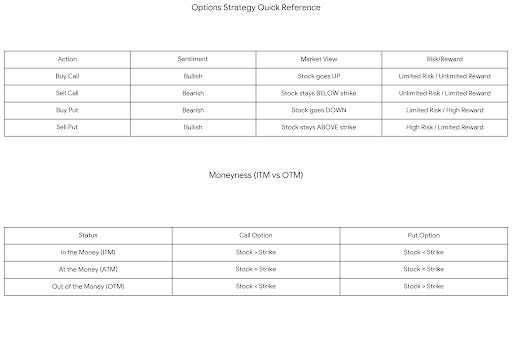
I hope this article helped to get a nice foundation for those looking to enter the options trading game. Need me to explain more or did I miss something? Please leave me any feedback in the comments below!